
Business development for recruiters depends on one wrong assumption: the data you’re using reflects what’s happening in the market right now. Unfortunately, this assumption has become an industry practice.
Most recruitment teams unknowingly work with historical data while trying to operate in a real-time market. Working with historical data means you’re working with stale data that cannot provide value in real-time.
And that usage reflects in how long it takes you to reach the right person, close a placement, or lose a lead.
Understanding why that happens starts with how recruitment data is actually collected.
In this article, we’ll be looking at how you can get rid of stale data and use live contact data, how this process can be automated, and what parts of your recruitment workflow can be altered for improvement.
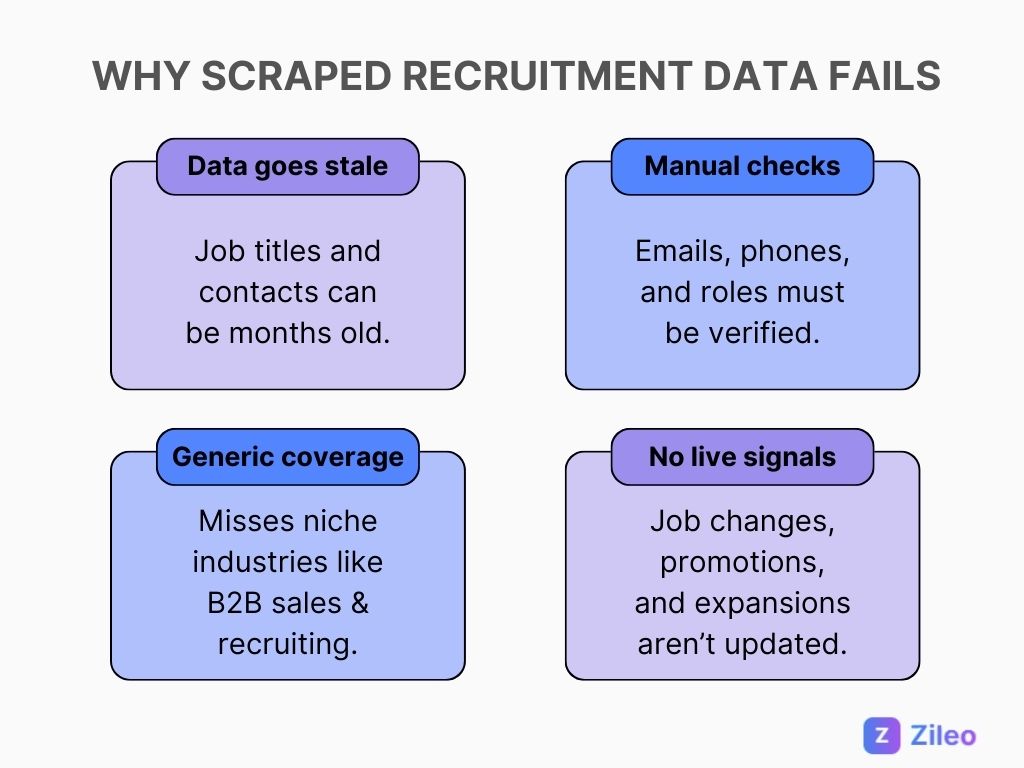
Most databases are generic. Platforms like Apollo, for example, provide access to a large pool of contacts, but they are not built for recruiters. If you’re expecting a ready-to-go, niche-focused lead list, you may be disappointed.
Here are a few reasons why:
In short, scraped data doesn’t work because it answers the question: “Who was in this role when the data was last collected?”
But recruiters need to know: “Who is in this role right now?”
B2B contact data can become outdated extremely quickly. At a minimum, B2B contact data can decay by 22.5% within a single year (source: Hubspot). This means nearly a quarter of a typical database can be stale within 12 months. And that’s the minimum threshold; this number can go up to 70%.
That’s why it’s so, so important to have updated data.
Live contact discovery, as implemented by Zileo, works differently:
Plus, Zileo automates this entire process. Not only do you get real-time signals, but Zileo also executes the entire sequence. That gives you a huge window of opportunity before competitors.
When you have scraped data from these large databases, you only get job titles. These job titles are mostly outdated. But in recruitment, job changes are the more important signals. This is because:
When you have access to all these updates, it leads to more relevant conversations and better conversion rates for placements.
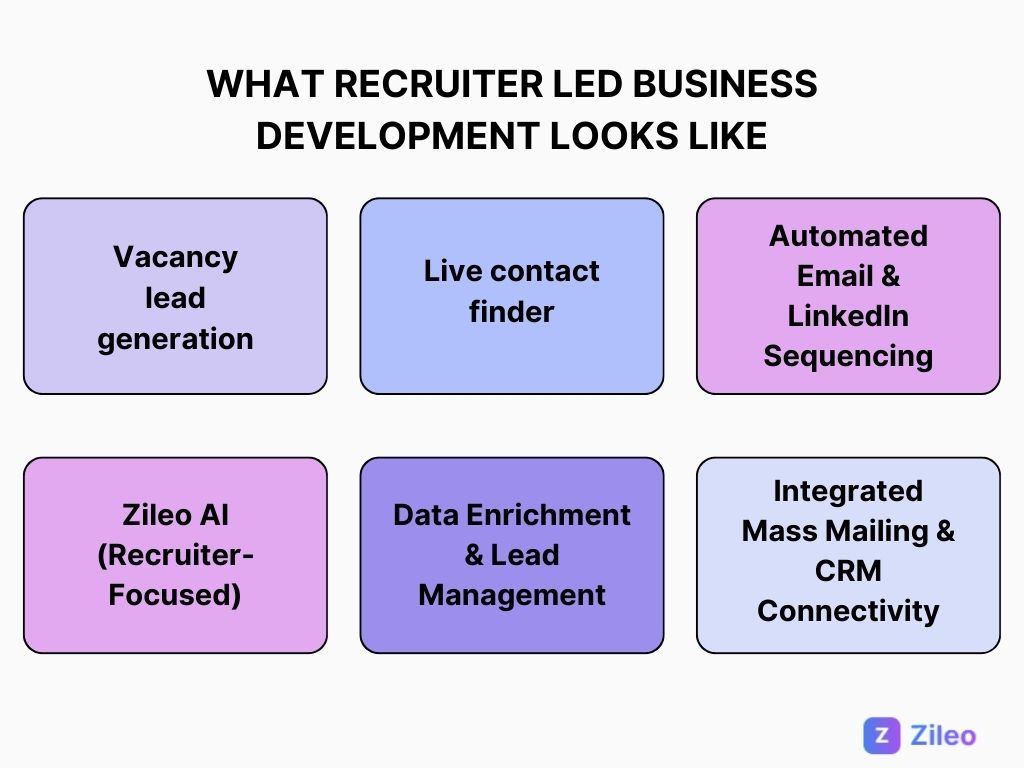
Capture 98%+ of live vacancies globally across all major job boards — including backfill and replacement hiring signals — so you know exactly which companies are actively hiring, right now.
Search LinkedIn in real time to identify the current hiring manager, HR lead, or decision-maker, with verified email and phone details. No scraped lists. No ex-employees.
Run structured outreach across email, LinkedIn messages, InMail, profile views, and follow-ups. This means client development happens consistently without manual chasing.
Reduce admin and research time. Zileo AI:
This feature keeps your CRM accurate and usable by enriching old records with live contact data. Plus, you can manage prospects by company, vacancy, or pipeline stage.
Re-engage your existing client database or launch targeted market outreach with warm, deliverability-safe emails and LinkedIn messaging, fully integrated with your CRM/ATS.
Big databases are popular because they cater to more people. The more people, the more popular that platform will be. However, when you use a generic database platform for niche industries, it won’t work.
The data will be less actionable, and the workflow will lead to a lot of admin work (because it’s not developed for recruiters or sales teams).
With Zileo, you not only have access to live contacts, but you’ve got automated sequencing, AI-driven lead refinement, and so much more built into one platform.
Try it here and get 50 leads for free: zileo.io